



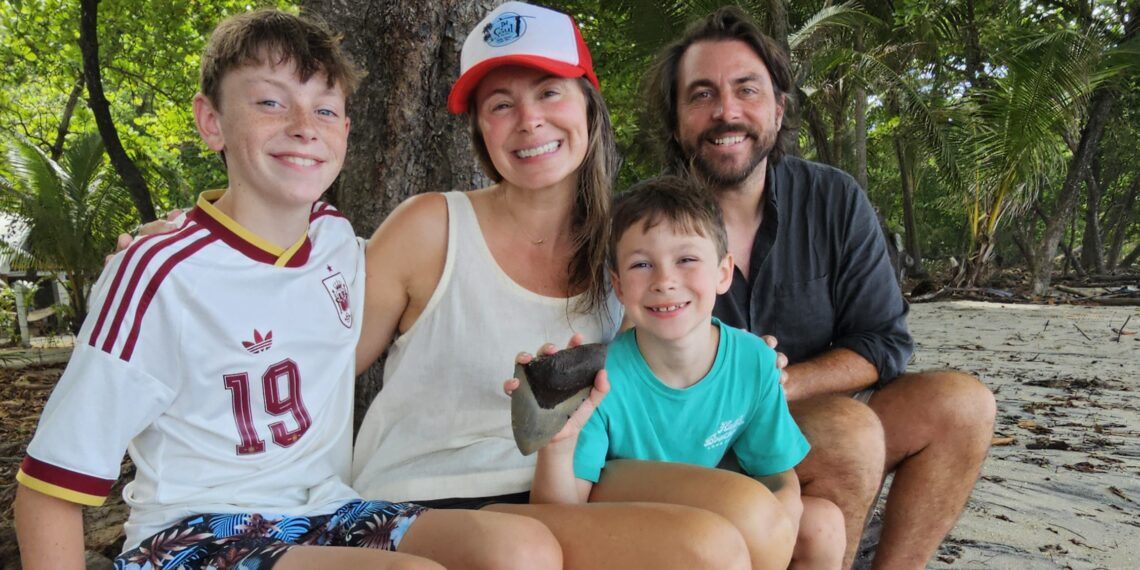
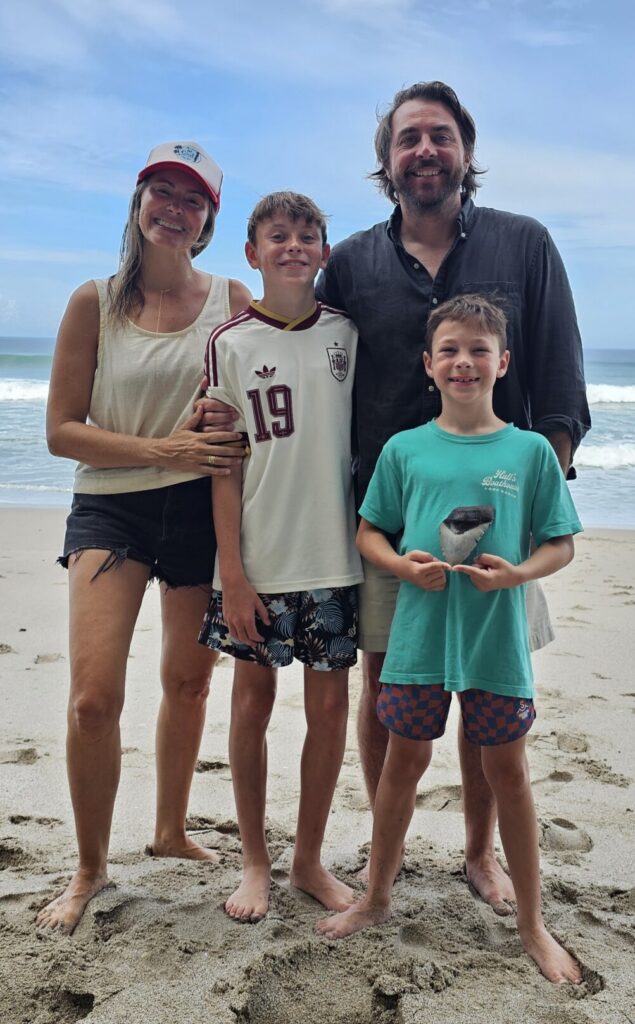
For one Atlanta family, Costa Rica was more than just another vacation. It was a chance to slow down, reconnect with nature, experience another culture, and give their children memories that could never be found behind a screen. On their second visit to Santa Teresa, their youngest son discovered something millions of years old waiting along the shoreline — a Megalodon shark tooth that turned an already unforgettable family trip into a story they will tell forever.
Tucker has always been a treasure hunter.
Wherever his family travels, he searches. A feather on a forest trail, a butterfly wing, an interesting flower, a shell, a tiny lizard, a bird’s nest — he is always looking closely at the world around him, searching for the little mysteries that most people walk past.
His parents, Ellie and Dave, have always joked that Tucker has a special ability to find treasures wherever they go.
But nothing prepared him for the treasure waiting on Santa Teresa Beach.
It was their first morning back in Costa Rica.
The family had returned to the place that had left such a strong impression on them during their first visit in 2021. The boys, Charlie and Tucker, were older now — seven and eleven — and excited to experience again the country they had only partially remembered from their first adventure.
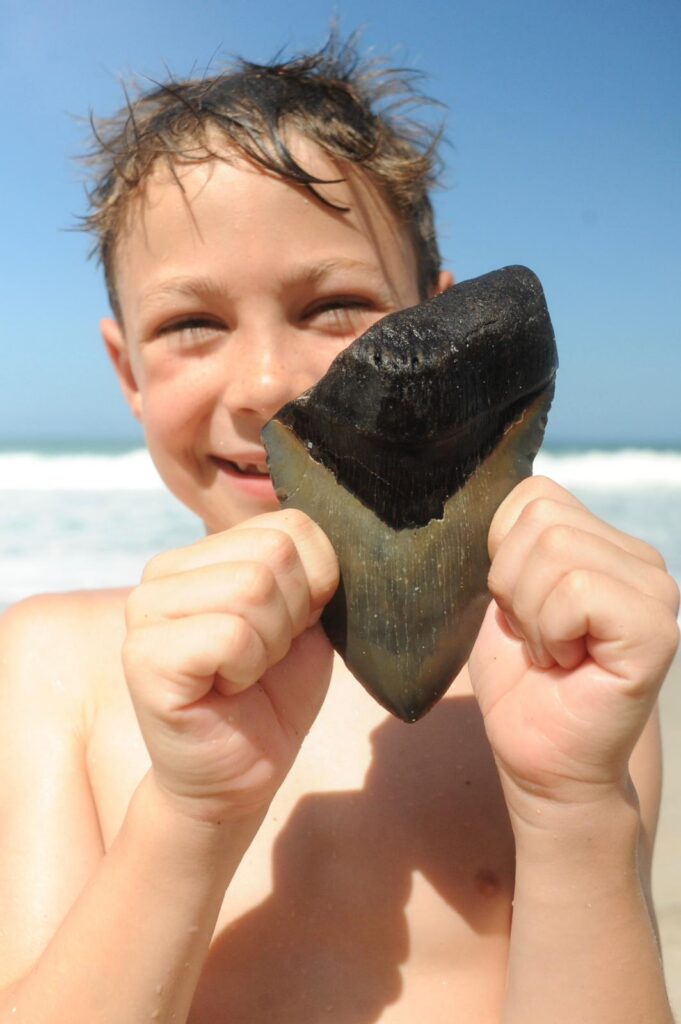
Walking along the beach, Tucker noticed something unusual near the waterline.
The ocean had briefly covered it, but as the water moved away, something appeared beneath the surface. He picked it up. And then he started running.
“He just started screaming and running down the beach,” Ellie remembers. “Charlie and I were with him, and we were like, ‘What? What is it?’”
Tucker ran back holding the discovery in his hand, barely able to contain his excitement.
Then he ran toward his father, who was relaxing on the sand.
“He said to his dad, ‘You’ll never guess what I found,’” Ellie laughs.
Dave had a pretty good idea. Knowing his son’s obsession with sharks, he guessed, “Is it a shark’s tooth?” Tucker pulled the treasure from behind his back.
“Even better.”
It was a giant Megalodon tooth. A prehistoric discovery from one of the largest sharks to ever exist on Earth. And Tucker knew immediately what he had found.
“He loves sharks,” Ellie explains. “He has shark books, shark things all over his room, and he’s always been fascinated by them.”
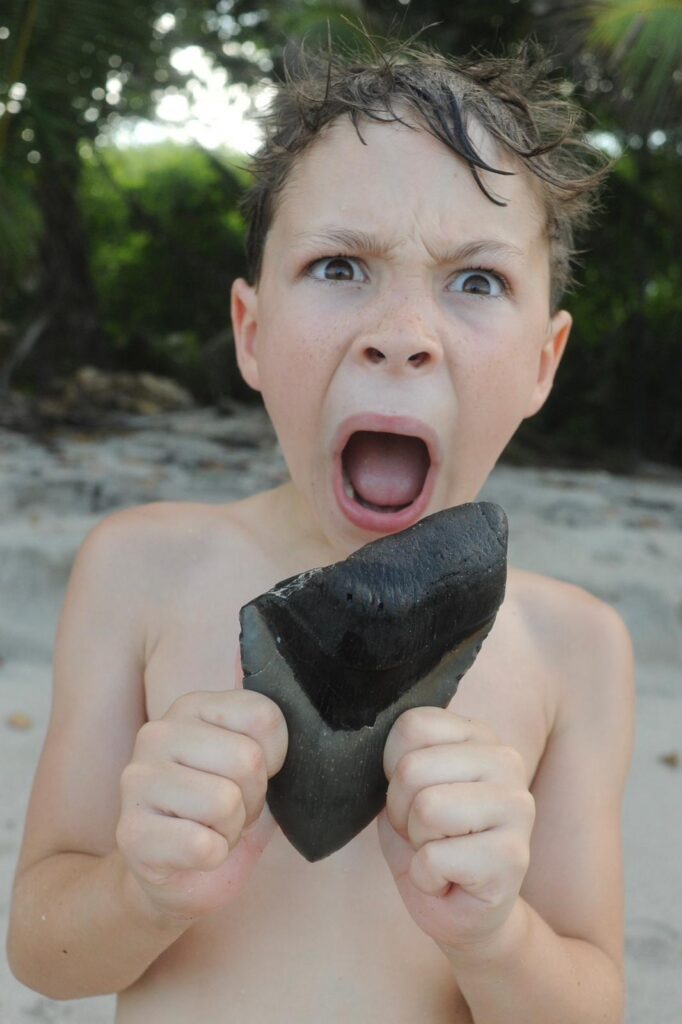
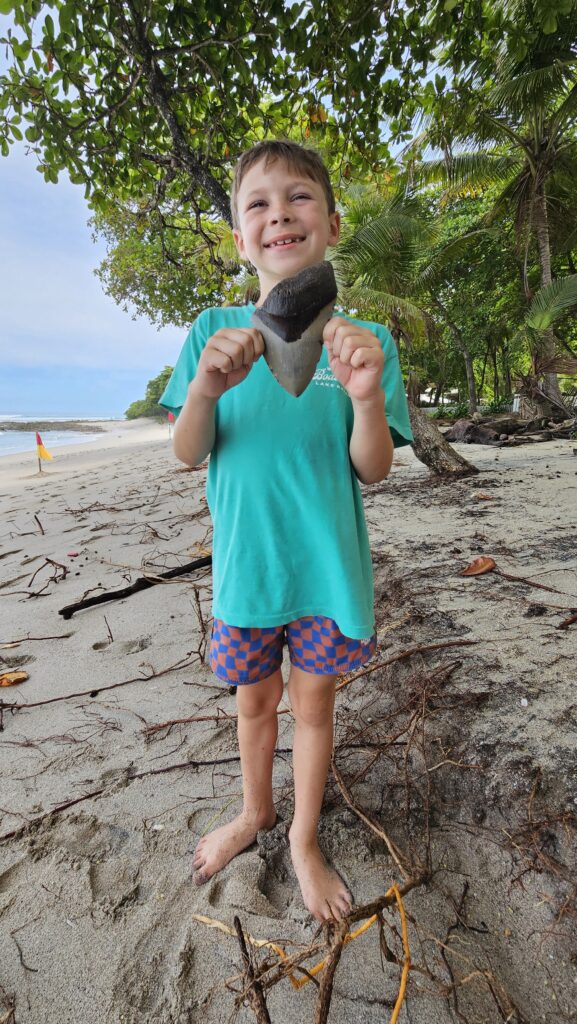
The tooth now sits proudly on their kitchen counter at home, where Tucker continues to pick it up, admire it, and show anyone who visits. He showed it to people on the beach that day. He ran to the lifeguard to share his discovery, he ran to strangers like our local resident ´Cosmo´ to share his story, and Cosmo was equally excited to share Tuckers story with the newspaper. Later that day Tucker FaceTimed family members. A photo posted online brought messages from friends amazed by the rare find.
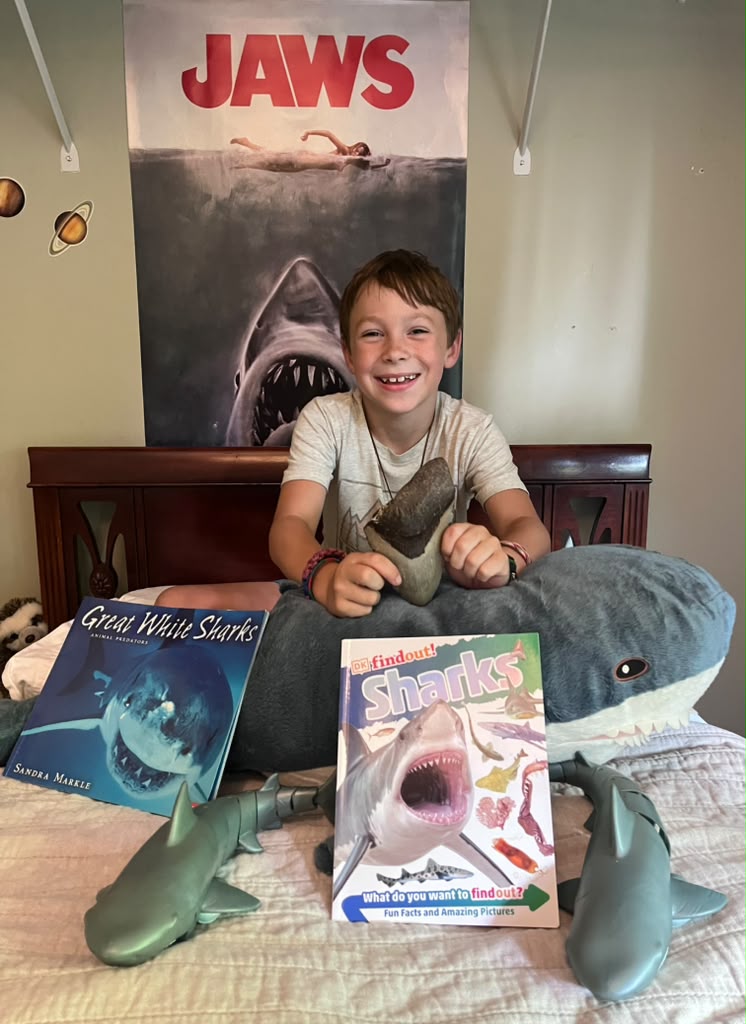
But the Megalodon tooth was more than just a lucky discovery.
It represented exactly why Ellie and Dave had chosen Costa Rica in the first place.
Why This Family Chose Costa Rica Over a Traditional Beach Vacation
Ellie and Dave first brought their family to Costa Rica in June 2021.
Atlanta was there home, and through Dave’s work they had already experienced traveling internationally with their children. They began realizing something surprising:
A family adventure in another country could sometimes cost less than staying close to home.
“We found that sometimes it was less expensive for our family to fly somewhere internationally than rent a house on a beach in Florida,” Ellie explains.
That discovery changed the way they looked at vacations. Instead of spending thousands of dollars surrounded by crowds and manufactured entertainment, they wanted their children to experience something real.
“We would much prefer allowing our kids to experience a different culture, a different language, new food, and nature,” Ellie says. For their family, Costa Rica offered something that could not be purchased.
Connection.
The chance for their children to see monkeys in the trees, walk barefoot on wild beaches, practice another language, taste different foods, and understand that the world was much bigger than their hometown.
A Family Vacation That Gives Children More Than Memories
When they first arrived in Costa Rica, Charlie and Tucker were only two and six years old. At that age, they mostly understood that they were on a fun vacation and that there were monkeys in the trees. But their parents remembered. They remembered the feeling of Santa Teresa. They remembered the freedom. They remembered the raw beauty of the coastline.
So when Ellie’s 40th birthday approached, she knew exactly what she wanted.
“I think for my 40th birthday, I’d like to go back to Santa Teresa,” she told Dave.
And that is exactly what they did. Five years later, the family returned to the same place that had captured their hearts. The boys remembered the important things. They remembered riding four-wheelers. They remembered monkeys on the beach.
And on their first morning back, they were greeted by one of Santa Teresa’s most famous residents — a troop of howler monkeys resting in the trees above where they were staying.
Why Santa Teresa Was the Perfect Family Destination
For Ellie and Dave, Santa Teresa offered something they struggled to find in more developed beach destinations. Space for their children to play and discover. Nature to bring their children closer to something other than cement sidewalks.
A feeling of being somewhere different.
They intentionally stayed on the north end of the beach because it felt quieter and less crowded while still being close enough to restaurants and town. They compared it to some popular beach destinations they had visited before.
“A couple years ago, we were in Florida, and there were eight rows of umbrellas set back from the ocean,” Dave says. “We thought, who would want to sit in these rows of umbrellas when you can access a beach as wild and essentially empty as Santa Teresa?”
That wildness was part of the attraction. Santa Teresa still feels connected to nature. The dirt roads, the jungle, the ocean, the night sky, the sounds of wildlife — all of it creates an experience that feels different from highly developed coastal destinations.
“It feels a lot different than the highly commercialized American coast,” Dave says. “That is part of the appeal.”
The Perfect Costa Rica Family Rhythm: Surf, Explore, Relax, Repeat
Many families visiting Costa Rica fill every day with scheduled tours and excursions.
Ellie and Dave discovered something different. They did not plan a packed itinerary. Instead, they created a simple rhythm. Wake up. Surf. Eat. Explore. Relax. Watch the sunset. Repeat.
The family rented surfboards and spent three mornings at Playa Hermosa helping the boys learn to surf. For them, those quiet mornings were some of the best moments of the trip. But surfing was only part of the adventure.
The boys loved riding four-wheelers through town, bouncing along the dirt roads, avoiding crabs crossing the path, and exploring everyday life in Santa Teresa. Even grocery shopping became an adventure.
“They loved navigating the supermarkets to find snacks,” Ellie says. “It was fun and different from experiences in the States, and it was educational for them to shop in Spanish and see different foods.”
Sometimes the smallest experiences become the biggest memories.
The Adventure You Don’t Have to Plan
While Ellie and Dave chose a slower rhythm for their own family adventure, they also noticed something important about Costa Rica — there is no single way to experience it.
Another family staying near them chose a completely different style of vacation. They filled their days with excursions: Montezuma Waterfall, a bioluminescent kayak tour, the Mal País zip line, and other adventures around the peninsula.
And that is the beauty of Costa Rica. Families can create the experience that fits them. For some, it is adventure every day. For others, it is waking up with the sunrise, walking the beach, watching monkeys move through the trees, learning to surf, searching for shells, and spending the evening beneath a sky full of stars.
For Ellie and Dave, the magic was found in the simple moments.
“We really loved just being in a peaceful rhythm of surf in the morning, relaxing in the afternoon, going down to search for shells, watching the sunrise and sunset, eating well, and doing it all again the next day,” Dave says.
A One-Week Costa Rica Family Vacation Filled With Memories
The family spent seven days in Costa Rica, arriving through a route that made the journey surprisingly easy. They flew directly from Atlanta to San José and then connected on the small plane to Cobano.
For families traveling with children, the convenience made a big difference. They left Atlanta in the morning and were enjoying the beach that same afternoon.
“It was pretty sweet,” Dave says. “Especially traveling with kids.”
Within hours, they had traded airport terminals for ocean waves, jungle sounds, and the feeling of being somewhere completely different.
Learning Costa Rica Through Culture, Food and Language
For Ellie and Dave, part of the joy of traveling was stepping outside what was familiar. Both enjoy practicing Spanish and experiencing the culture of another country. They found that Santa Teresa offered the perfect balance. Spanish is part of everyday life, but the community is also accustomed to welcoming international visitors.
“It didn’t prohibit you in any way,” Ellie says. “Everybody would try to speak English because we would try to speak Spanish back.”
The result was not a barrier. It was an opportunity. For their children, even simple moments — ordering food, shopping, interacting with locals — became small lessons in understanding the world.
The Flavors of Santa Teresa
Every family adventure includes food memories, and Santa Teresa gave them plenty. For breakfast, their favorite place was El Patio. They loved the welcoming atmosphere, the surfers arriving after morning sessions, and the feeling of being part of the community. The boys especially loved the smoothies.
For lunch, they enjoyed Roca Mar, with its Mediterranean flavors and beachfront setting.
For dinner, favorites included Katana, where Ellie celebrated her birthday, along with Zula and Satori Sushi.
They also enjoyed visiting local sodas, discovering more traditional Costa Rican flavors and experiencing the variety that makes Santa Teresa’s food scene so unique.
A Family Connected Through Nature
While Tucker searched the shoreline for treasures, Dave found his own adventure in the natural world. An avid bird lover, he kept a list of the species he discovered during their time in Costa Rica. Each day brought something new to notice.
A bird in the trees. A monkey overhead. A changing ocean. A sunset. A night sky filled with stars. Costa Rica rewards curiosity.
And that curiosity is exactly what the family hoped to encourage in their children.
Protecting the Magic of Santa Teresa
For Ellie and Dave, the extra effort required to reach Santa Teresa is part of what makes the destination special. They hope the journey helps protect the character that brought them here. They have intentionally avoided some more developed coastal destinations because they wanted something different.
Something less commercial. Something closer to nature.
Santa Teresa offered them a window into Costa Rican culture, while also showing them how people from around the world have blended into the community — creating new traditions, new foods, and a shared appreciation for the Pura Vida lifestyle.
A Treasure That Will Last Forever
The Megalodon tooth may have been the most unexpected moment of their trip, but it was not the only treasure the family discovered.
The real treasures were the experiences surrounding it. The mornings surfing together. The laughter bouncing along dirt roads. The boys discovering a different culture. The monkeys waiting in the trees. The meals shared around a table. The quiet moments on a beach that still feels wild.
Tucker’s prehistoric discovery simply became the symbol of everything they love about Costa Rica. A place where children can still explore. A place where curiosity is rewarded. A place where the natural world can surprise you when you least expect it.
For Ellie, Dave, Charlie and Tucker, Costa Rica was never just a vacation.
It became part of their family story. And they already know it will not be their last chapter here.
“We hope to come back many more times,” Ellie says. Because some places you visit. And some places become part of you.
A Shark Bigger Than Anything Alive Today
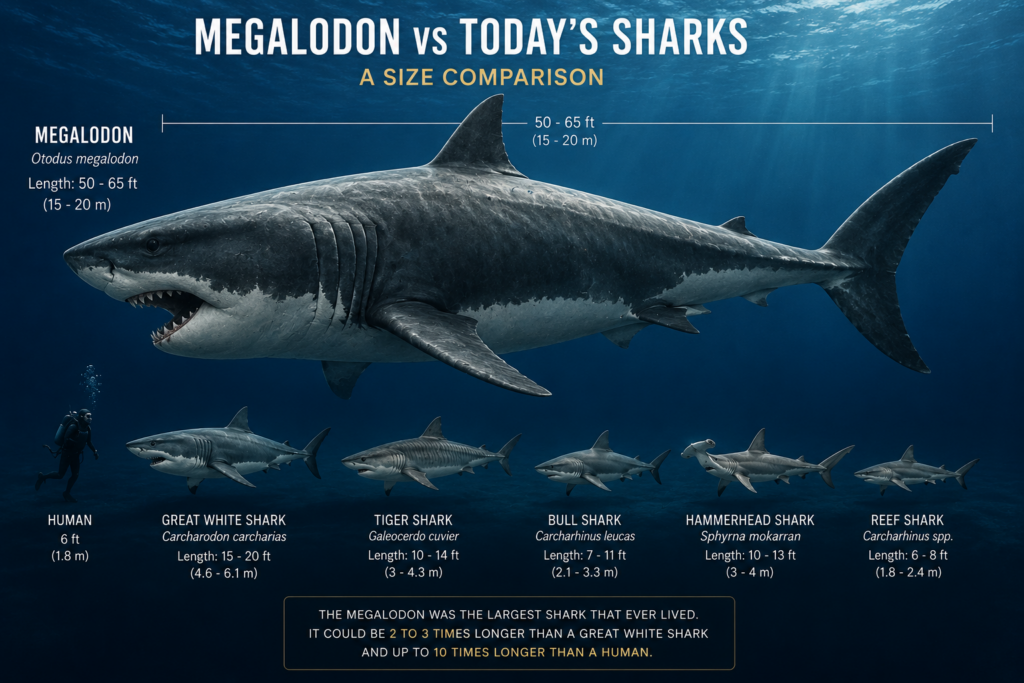
Megalodon was the largest shark ever known to have lived, dominating Earth’s oceans for millions of years. Growing to an estimated 15 to 20 metres (50–65 feet) in length, this prehistoric predator hunted whales and other large marine animals before disappearing around 3.6 million years ago. Discover what scientists know about Megalodon’s size, diet, habitat, hunting techniques and extinction.
Long before humans looked out over the ocean, before beaches had footprints, and before boats crossed the waves, the seas belonged to a predator unlike anything alive today.
A shark so enormous that, millions of years later, it would inspire some of Hollywood’s most terrifying ocean stories.
The Megalodon.
Its scientific name, Otodus megalodon, means “giant tooth,” and that name tells the story of this incredible creature. The only evidence left behind by this ancient shark is often its teeth — massive, triangular fossils that reveal the existence of a predator that ruled the oceans for millions of years.
The Megalodon lived approximately 23 million to 3.6 million years ago, during the Miocene and early Pliocene epochs, when Earth’s oceans were filled with giant marine animals. Scientists believe this enormous shark could grow between 50 and 65 feet long, making it the largest shark known to have ever existed.
To understand its size, imagine a predator longer than a school bus moving silently through warm prehistoric seas.
Its jaws were unlike anything found in today’s ocean. A fully grown Megalodon had rows of powerful teeth, with some fossils measuring more than 7 inches long. Like modern sharks, it constantly replaced lost teeth, meaning one shark could leave behind thousands of fossilized reminders of its existence.
These teeth were not made for delicate eating.
They were designed for power.
Megalodons were apex predators, meaning they sat at the very top of the food chain. Scientists believe they hunted large marine animals, including ancient whales, dolphins, seals, and giant sea turtles. Their enormous size, speed, and powerful bite made them one of the most dominant hunters Earth has ever known.
Perhaps one of the most fascinating facts about the Megalodon is that even its babies were giants. Researchers believe newborns may have measured around 6 feet long — already larger than many adult humans. From the moment they entered the ocean, they were built to survive.
The World That Created a Giant
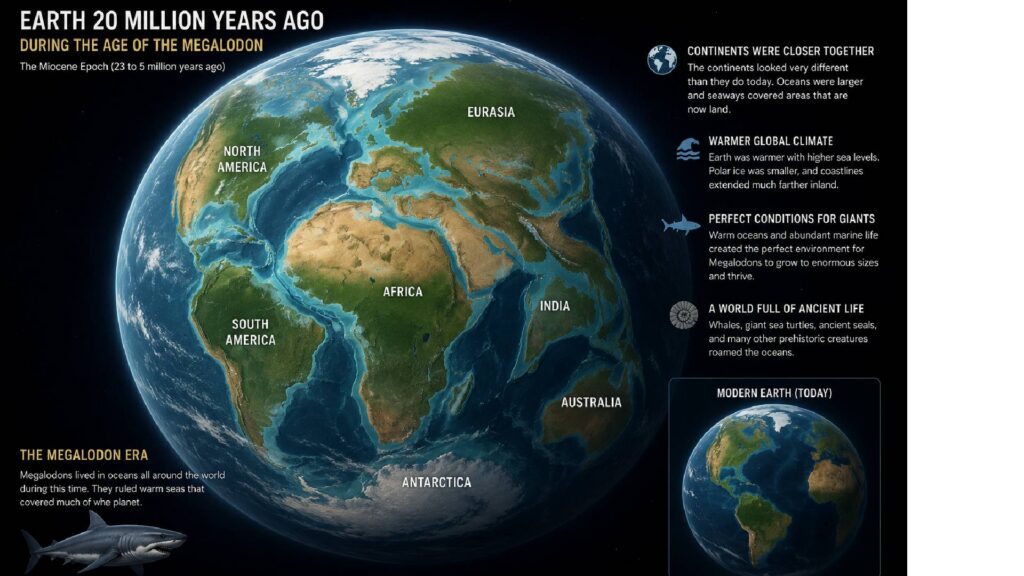
When the Megalodon ruled the oceans, Earth was a very different place.
These giant sharks appeared millions of years before humans existed. There were no cities, no civilizations, and no humans walking the planet. Instead, the continents were home to early ancestors of animals we recognize today, including primitive elephants, horses, and other mammals that were still evolving.
The dinosaurs were already gone — they had disappeared about 66 million years earlier — but Earth was entering a new chapter of life. The continents had moved close to their modern positions, mountain ranges were still forming, and the planet’s warmer oceans supported a remarkable variety of giant marine creatures.
The ocean itself was built to support giants.
During the Megalodon’s time, ancient whales and other large marine animals were much more abundant, providing the enormous amount of energy required by a predator of this size. A shark reaching 50–65 feet long would have needed a tremendous amount of food to survive, likely consuming hundreds of pounds of prey during feeding events.
Compared with today’s great white shark — which typically reaches around 15–20 feet — the Megalodon lived in a completely different world.
A great white can survive by hunting seals, sea lions, fish, and smaller marine animals. The Megalodon needed much larger prey, including prehistoric whales and other massive sea creatures that could sustain a hunter at the top of the ancient food chain.
The story of the Megalodon is not only the story of the largest shark ever known.
It is the story of an ocean ecosystem powerful enough to create — and feed — a true giant.
The End of an Ocean Giant
For millions of years, Megalodons traveled the world’s oceans. Fossil teeth have been discovered on every continent except Antarctica, showing that these sharks lived across a vast range of warm seas.
But even the greatest predators eventually face a changing world.
Around 3.6 million years ago, the Megalodon disappeared. Scientists believe a combination of factors contributed to its extinction, including cooling ocean temperatures, changes in sea levels, declining populations of large prey animals, and competition from other marine predators.
The giant shark was gone.
But the mystery remained.
Every fossil tooth discovered today is a small window into a lost ocean — a reminder that the beaches we walk, the waves we surf, and the seas we explore have existed through unimaginable chapters of Earth’s history.
The Megalodon was not a legend.
It was real.
A 60-foot shadow beneath ancient waves.
A predator powerful enough to become a symbol of the ocean’s deepest mysteries.
And millions of years later, its story still captures our imagination.
What Was Earth Like Before Megalodon Lived?






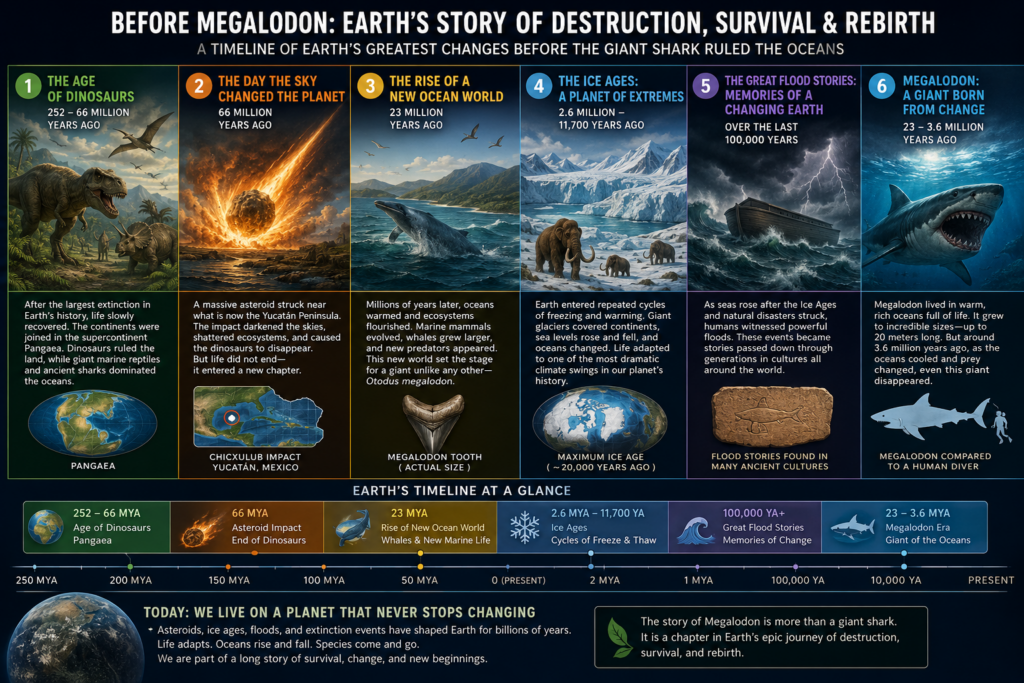
Long before Megalodon ruled the oceans, Earth experienced some of the greatest changes in its history. Giant continents formed and drifted apart, dinosaurs dominated the land, an asteroid changed life forever, and new oceans emerged before the world’s largest shark ever appeared.
Long before humans walked the planet, Earth was already a world of unimaginable change.
The planet we know today is not the first version of Earth. Continents have moved, oceans have opened and disappeared, climates have shifted from tropical worlds to frozen landscapes, and countless species have risen and vanished.
Earth has experienced many moments when life was nearly erased — only to begin again.
1. The Age of Dinosaurs: A Different Earth
252–66 million years ago
After the largest known mass extinction in Earth’s history, the Permian-Triassic extinction, life slowly recovered.
The continents were joined together in a giant supercontinent called Pangaea. The world looked nothing like today.
Dinosaurs eventually rose to dominate the land, while ancient reptiles ruled many of the oceans.
The seas were filled with creatures that seem almost imaginary today:
- giant marine reptiles
- enormous fish
- ancient sharks
- ammonites and strange ocean predators
The oceans were not quiet places. They were ancient battlefields of evolution.
2. The Day the Sky Changed the Planet
66 million years ago
A massive asteroid struck near what is now the Yucatán Peninsula in Mexico.
The impact did not just create a crater — it changed the direction of life on Earth.
The skies darkened.
Temperatures shifted.
Food chains collapsed.
The dinosaurs disappeared.
But the story did not end.
Small mammals, birds, reptiles, and ocean creatures that survived inherited a changed world.
Earth had done what it had done many times before:
It destroyed one chapter and opened another.
3. The Rise of a New Ocean World
23 million years ago
Millions of years after the dinosaurs vanished, the oceans entered a new era.
The continents moved closer to their modern positions.
Ocean temperatures changed.
Marine ecosystems exploded with new opportunities.
And into this world appeared one of the greatest predators ever to exist:
Otodus megalodon.
This was not a leftover from the dinosaur age.
Megalodon was born from a completely new Earth — a planet rebuilt after catastrophe.
4. The Ice Ages: A Planet of Extremes
2.6 million years ago–11,700 years ago
Long after Megalodon first appeared, Earth entered repeated cycles of freezing and warming.
Huge glaciers covered parts of the Northern Hemisphere.
Sea levels rose and fell dramatically.
During the coldest periods:
- coastlines changed
- oceans became colder
- entire ecosystems shifted
The planet was constantly reshaping itself.
For humans living during the later Ice Age, these changes became part of our earliest stories.
5. The Great Flood Stories: Memories of a Changing Earth
As humans spread across the planet, they experienced dramatic natural events:
- rising seas after glaciers melted
- powerful storms
- river floods
- earthquakes
- volcanic eruptions
Many ancient cultures developed stories of great floods and worlds being transformed.
From Mesopotamia to Indigenous traditions around the world, flood stories appear again and again.
Science explains these events through geology and climate.
Human cultures preserved them through stories.
Both reveal the same truth:
Earth is a planet that changes.
6. Megalodon: A Giant Born From Change
Megalodon lived in a world where oceans were warmer than today and food was abundant.
Whales were evolving and becoming larger.
The seas were full of life.
A shark estimated to reach lengths of up to 15–20 meters became one of the greatest predators the oceans have ever known.
But even giants are temporary.
Around 3.6 million years ago, Megalodon disappeared.
The exact reasons are still debated, but scientists believe changing oceans, declining prey, competition, and climate shifts all played a role.
Once again:
The planet changed.
And life adapted.
The Bigger Story
Maybe the greatest story of Megalodon is not about a monster shark.
It is about Earth itself.
A planet that has been shattered by asteroids, frozen by ice ages, reshaped by floods, and transformed by extinction events — yet life continues to return.
The oceans we see today are not the first oceans.
The creatures swimming in them are not the first inhabitants.
Earth is a world of endings and beginnings.
And Megalodon was one of the most magnificent chapters ever written in the history of the sea.
How Do Megalodon Teeth End Up on Beaches?
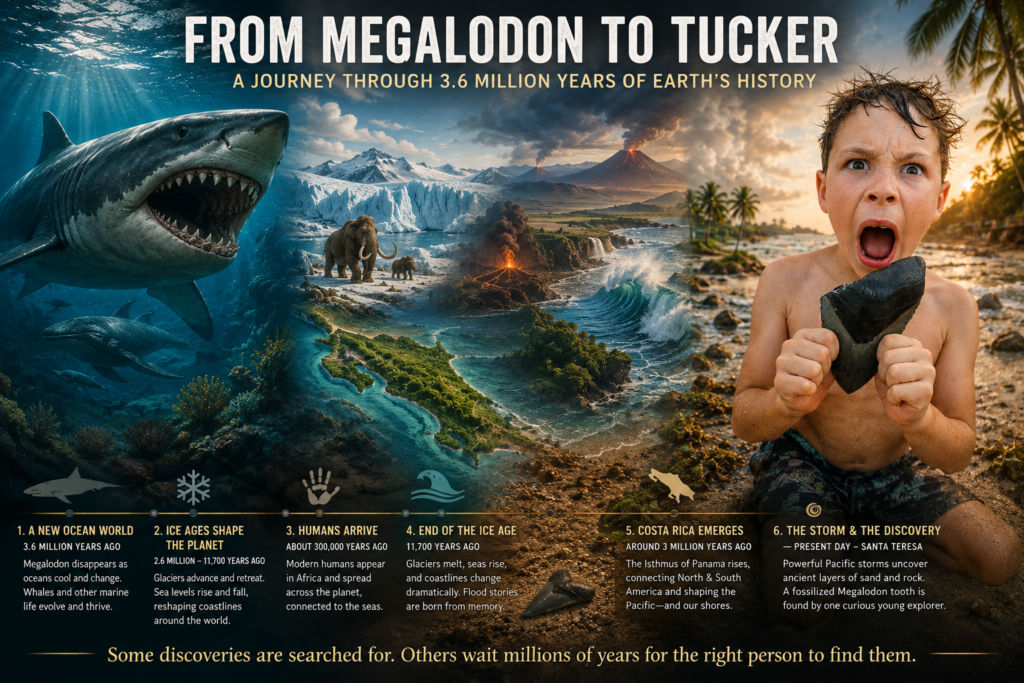
Finding a Megalodon tooth on a beach may seem impossible, but every fossil has an incredible story. From the extinction of the giant shark millions of years ago to changing oceans, rising coastlines, powerful storms and natural erosion, discover how one ancient tooth eventually reached the shores of Santa Teresa, Costa Rica, where young Tucker made the discovery of a lifetime.
How a Giant Shark’s Tooth Reached a Costa Rica Beach
When Megalodon disappeared from Earth’s oceans around 3.6 million years ago, its story did not end.
It simply became part of a much larger story—one written by the forces of nature over millions of years.
The fossil Tucker discovered on a Santa Teresa beach survived an extraordinary journey through time. Long before it rested beneath the sand waiting to be found, the world itself was changing.
A New Ocean Without Its Greatest Predator
As Megalodon vanished, the oceans continued to evolve.
Whales grew larger and more diverse, becoming the giants we recognize today. Smaller sharks, dolphins, seals, and countless marine species filled ecological roles once dominated by the ocean’s largest predator.
The Pacific Ocean never stood still.
Ocean currents shifted.
Sea temperatures rose and fell.
Marine life adapted again and again.
The age of Megalodon had ended, but the ocean continued writing new chapters.
Ice Changed Everything
Beginning about 2.6 million years ago, Earth entered a series of Ice Ages.
Massive glaciers covered large parts of the Northern Hemisphere.
As enormous amounts of water became trapped in ice, sea levels dropped by more than 120 metres.
Coastlines looked completely different from those we know today.
When the climate warmed, glaciers melted and the oceans rose once again, flooding valleys and creating many of today’s coastlines.
The beaches we walk today are surprisingly young in Earth’s history.
A New Species Appears
Around 300,000 years ago, modern humans appeared in Africa.
Unlike every giant predator before them, humans did not rely on enormous teeth or incredible size.
Instead, curiosity, imagination, and cooperation became our greatest survival tools.
Eventually people spread across every continent, always drawn toward rivers, coastlines, and oceans that had shaped life for millions of years before our arrival.
Costa Rica Emerges
One of the most important events in our region happened long before the first people reached Central America.
Around three million years ago, the Isthmus of Panama rose from the sea, joining North and South America.
This remarkable geological event changed ocean currents around the world.
It helped create the coastlines of Costa Rica, influenced marine ecosystems throughout the Pacific, and even affected global climate.
The beaches of Santa Teresa exist today because Earth itself never stopped changing.
Nature Never Stops Moving
Even after millions of years buried beneath layers of sediment, a fossil is never completely at rest.
Waves pound the coastline every day.
Winter swells erode rocky cliffs.
Heavy rains carry sediment toward the sea.
Earthquakes slowly lift parts of the coastline.
Powerful storms reshape beaches in a matter of hours.
Every season, the Pacific uncovers shells, driftwood, volcanic rocks—and sometimes something extraordinary.
Scientists cannot say exactly when Tucker’s Megalodon tooth was released from the rocks that protected it for millions of years.
But nature has a way of revealing hidden treasures when the time is right.
The Gift of the Pacific
Not long before Tucker’s family visited Santa Teresa, powerful Pacific swells and storms battered the Nicoya Peninsula.
Huge waves rearranged sandbars, exposed new layers of sediment, and stripped away beaches that had remained unchanged for years.
It is entirely possible that one of those storms uncovered the fossil shortly before Tucker arrived.
If so, the Pacific Ocean had been carrying this remarkable piece of history through millions of years of geological change—only to place it, for a brief moment, within reach of one curious young explorer.
A Journey Through Time
When Tucker bent down to pick up what looked like an unusual rock, he wasn’t simply finding a fossil.
He was holding a survivor.
A tooth from an animal that hunted ancient oceans.
A relic that endured extinction, shifting continents, Ice Ages, rising seas, and countless storms before finally emerging on a beach in Costa Rica.
For millions of years, nature protected its secret.
Then, one ordinary day, it decided the time was right to give that story to a young boy with curious eyes.
Related Articles
Best beachfront restaurants in Santa Teresa guide
Best things to do in Santa Teresa