

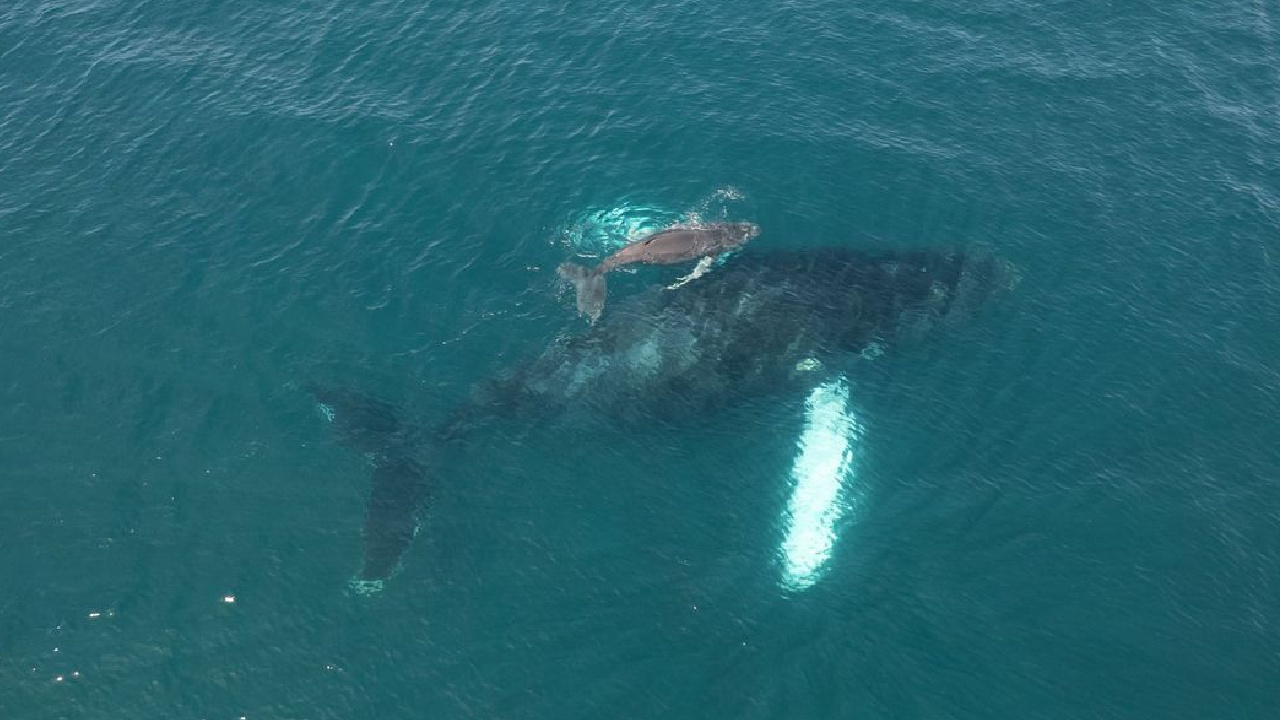
Out past the rolling surf of Santa Teresa, where the horizon blurs into sky and salt, a quieter story unfolds beneath the surface. It’s a story older than our roads, older than our towns, older than the first footprints in this sand. Twice a year, the ocean in front of us becomes a living highway for some of the largest, most intelligent beings on Earth—migrating whales moving with purpose, memory, and something that feels a lot like emotion.
This isn’t just whale watching. This is witnessing a migration written into the DNA of the planet.
The Two Great Migrations: North Meets South
Santa Teresa sits in a rare sweet spot along the Pacific coast of Costa Rica, where two distinct populations of whales pass through each year.
From December to April, humpback whales arrive from the cold, nutrient-rich waters of the North Pacific—places like Alaska and Canada. These whales travel thousands of kilometers to reach the warm tropical waters of Costa Rica, where they mate, give birth, and nurture their young.
Then, as if choreographed by the ocean itself, a second wave arrives between July and October, migrating up from the Southern Hemisphere—from regions like Antarctica and Chile.
Few places in the world offer this kind of double season. Here, the show runs nearly year-round.
Here is your guide to the different whales found in our waters.
The Stars of the Show: Humpback Whales
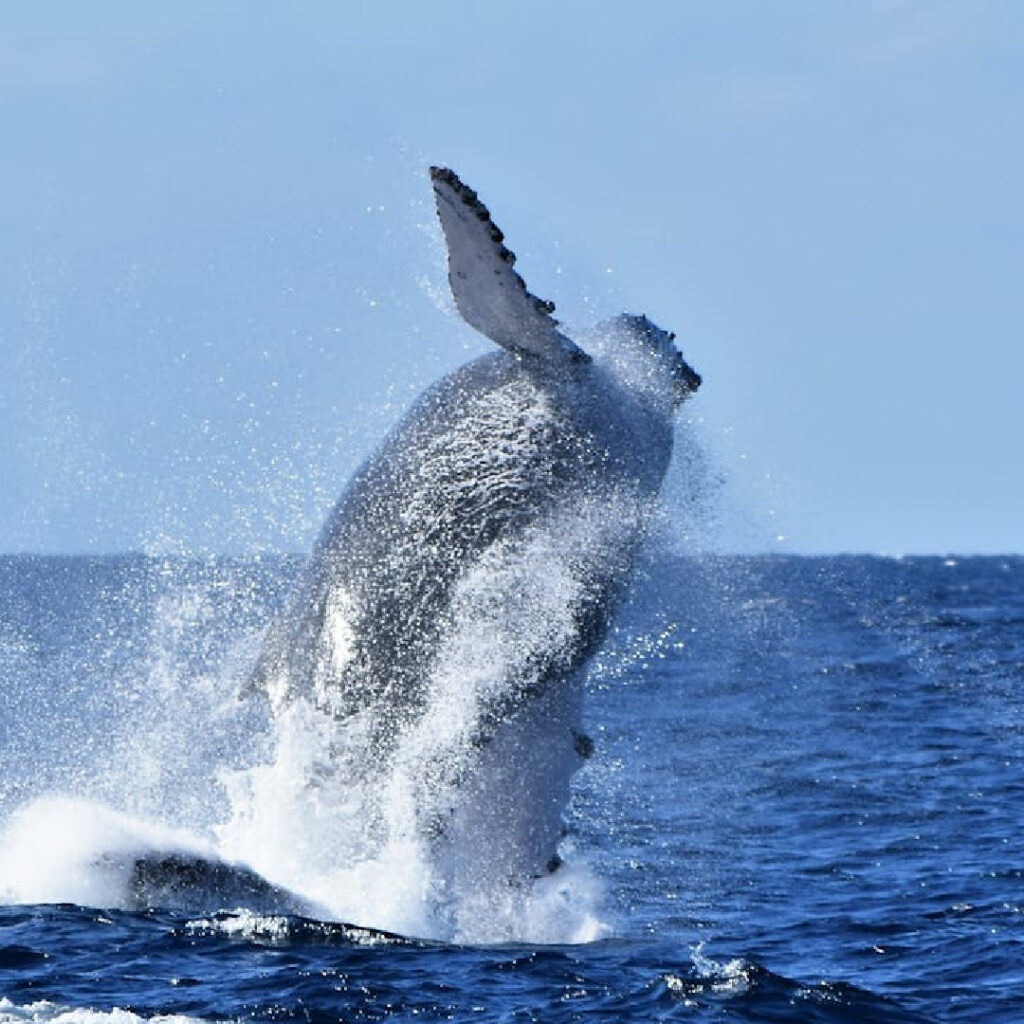
The most common visitors are humpback whales, known scientifically as Megaptera novaeangliae. These are the acrobats of the ocean—famous for breaching, tail-slapping, and launching their massive bodies out of the water with a grace that makes no sense for something weighing up to 40 tons.
But it’s not just spectacle.
Humpbacks are known for their complex songs, intricate vocal patterns that can travel for miles underwater. These songs evolve over time, almost like cultural trends passed between whale populations. Scientists still don’t fully understand their purpose, but they’re believed to play a role in mating, social bonding, and long-distance communication.
One of the most astonishing discoveries scientists have made about humpback whales is that their songs don’t just communicate—they evolve. Entire whale populations can suddenly begin singing new versions of songs that spread across oceans almost like cultural movements in human society. Researchers studying humpbacks in the Pacific discovered that whales from one region slowly adopted the song patterns of neighboring populations until, over time, thousands of whales across enormous distances were singing nearly the same evolving melody. The old songs disappeared. New ones replaced them.
Some scientists now describe humpback song as one of the clearest examples of non-human culture ever documented in the wild. These are not random sounds echoing through the sea. They are structured compositions built from repeating themes and rhythms that can last for hours, changing subtly year after year as if the ocean itself were rewriting the music.
Other whale species in our oceans
Whale Watching in Santa Teresa: Where Two Oceans of Life Collide
There are places in the world where nature performs. And then there are places where nature converges—quietly, powerfully, without asking for attention.
Santa Teresa is one of those places.
Out beyond the surf breaks and sunburnt shoulders, the Pacific isn’t just stretching into the horizon—it’s carrying life between hemispheres. Not one migration. Two. Entire populations of whales crossing paths through the same corridor of ocean, just offshore from where you’re drinking your morning coffee barefoot in the sand.
Most people don’t even realize what’s moving beneath them.
The Double Migration: A Rare Window on Earth
We touched on it—but it deserves a deeper dive, because this is what makes this coastline quietly extraordinary.
Santa Teresa sits along a migratory corridor influenced by the Eastern Tropical Pacific system, where currents, temperature shifts, and underwater geography create a kind of marine intersection point.
When northern humpbacks from Alaska and California arrive between December and April, they’re not just passing through randomly—they’re following generations of inherited routes shaped by ocean currents like the North Equatorial Current.
Months later, the southern population rises from Antarctica and Chile, guided by a completely different set of currents, including the Humboldt Current.
Here’s the wild part:
These two populations don’t mix.
They use the same waters—but at different times of year, like ships passing in the night on a schedule written long before humans were paying attention.
Costa Rica, especially along the Nicoya Peninsula, is one of the only places in the world where you can witness both migrations in a single year.
That’s not a tourism tagline—that’s a biological anomaly.
Not Just Humpbacks: Who Else Is Out There?
The humpbacks (Megaptera novaeangliae) are the headliners—the aerial artists, the splash-makers.
But they’re not alone out there.
Bryde’s Whales (The Locals)
Balaenoptera edeni
These are the year-round residents of Costa Rican waters. Sleek, fast, and less dramatic than humpbacks, Bryde’s whales tend to avoid the spotlight. They don’t breach often, but they’re powerful swimmers and often travel alone or in small groups.
Think of them as the quiet locals who’ve been here the whole time.
Blue Whales (The Ghost Giants)
Balaenoptera musculus
The largest animal to have ever lived on Earth—and yes, they pass through the broader Pacific waters of Costa Rica, though sightings are rare.
A blue whale can reach 30 meters (100 feet) and weigh over 150 tons. Its heart alone is the size of a small car.
You probably won’t see one. They prefer to stay in colder waters of the southern pacific.
But knowing they could be out there changes the way you look at the ocean.
Sperm Whales (The Deep Divers)
Physeter macrocephalus
These are the deep-sea legends. Sperm whales can dive over 2,000 meters in search of squid, holding their breath for more than an hour.
They’re less common to see close to shore, but they inhabit deeper offshore waters along the Pacific coast.
Massive heads. Complex social structures. Communication clicks so powerful they can stun prey.
They don’t just live in the ocean—they explore its depths like astronauts.
Pilot Whales & False Killer Whales
Globicephala macrorhynchus
Pseudorca crassidens
Highly social, often traveling in pods, these species blur the line between dolphin and whale behavior. They’re intelligent, coordinated hunters and occasionally seen in Costa Rican waters.
If humpbacks are poets, these guys are street gangs with sonar.
A Living Nursery: Birth, Bond, and Survival
Let’s zoom in tighter.
When humpbacks arrive here, they’re not sightseeing—they’re building the next generation.
Mothers give birth in warm, shallow waters where calves have a higher chance of survival. A newborn calf rises to the surface within minutes, instinct kicking in like a switch flipping on.
For the next months, the pair becomes inseparable.
The calf learns:
- How to swim efficiently
- How to breathe and dive
- How to communicate
All while the mother burns through her own body reserves, fasting and feeding her calf milk richer than anything you’ll find on land.
There’s no daycare out here.
Just instinct, patience, and one of the strongest maternal bonds in the natural world.
Whale Watching Guide: What You Might See (And When)
Best Times to See Whales in Santa Teresa
- December – April: Northern humpbacks (mating & calving season)
- July – October: Southern humpbacks (peak activity, highest sightings)
- Year-round: Occasional Bryde’s whales
What to Watch For
- Breaching: Full-body launch out of the water (rare, unforgettable)
- Tail Slaps: Loud smacks used for communication or display
- Blow (Spout): The first sign—look for a misty spray on the horizon
- Spyhopping: A curious whale lifting its head above water
Conditions Matter
- Early mornings = calmer seas
- Light winds = better visibility
- Post-rain clarity can vary, but whales don’t mind storms—they just go deeper
Respect the Encounter
Good operators follow responsible whale watching guidelines: Keep safe distances, Limit time with each whale, Never chase or surround, Because this isn’t a show. It’s a passage.
Ancient Travelers in a Modern World
Long before electricity, whales lit our nights—literally. Whale oil fueled lamps across cities, driving industrial-scale hunting that nearly erased them from existence.
Today, protections led by groups like the International Whaling Commission have helped populations recover—but not completely, and not everywhere.
The ocean still carries scars. And yet—they return. Year after year. Route after route. Generation after generation.
Something More Than Instinct
You can call it biology. You can call it evolution.
But when you’re sitting on a boat off Santa Teresa, watching a mother guide her calf through open water with a patience that feels almost human… it’s hard not to wonder if there’s something deeper at play.
Whales communicate across miles. They remember routes across decades. They adapt songs across oceans. They are, without question, intelligent. And maybe—just maybe—they’re tuned into something we’ve forgotten how to hear.
Field Guide to Whale Watching: Santa Teresa Region
Why This Area Works
The waters off the Nicoya Peninsula are shaped by underwater drop-offs and currents influenced by the Cocos Plate, creating ideal migratory conditions.
Seasonal Breakdown
- Northern Hemisphere humpbacks → breeding migration
- Southern Hemisphere humpbacks → separate population, different timing
- Overlap of migratory corridors makes this region globally unique
Behavior to Watch
- Breaching = communication or play
- Tail slaps = signaling or competition
- Spyhopping = environmental awareness
Distance & Ethics
Responsible tours follow guidelines supported by the International Whaling Commission:
- No chasing
- No surrounding
- Limited interaction time
Why It Matters
Whale watching, when done right, supports conservation and replaces the extractive industries that once nearly wiped them out.
Why They Come: Warm Water, New Life
The reason whales migrate here is simple, and powerful: survival of the next generation.
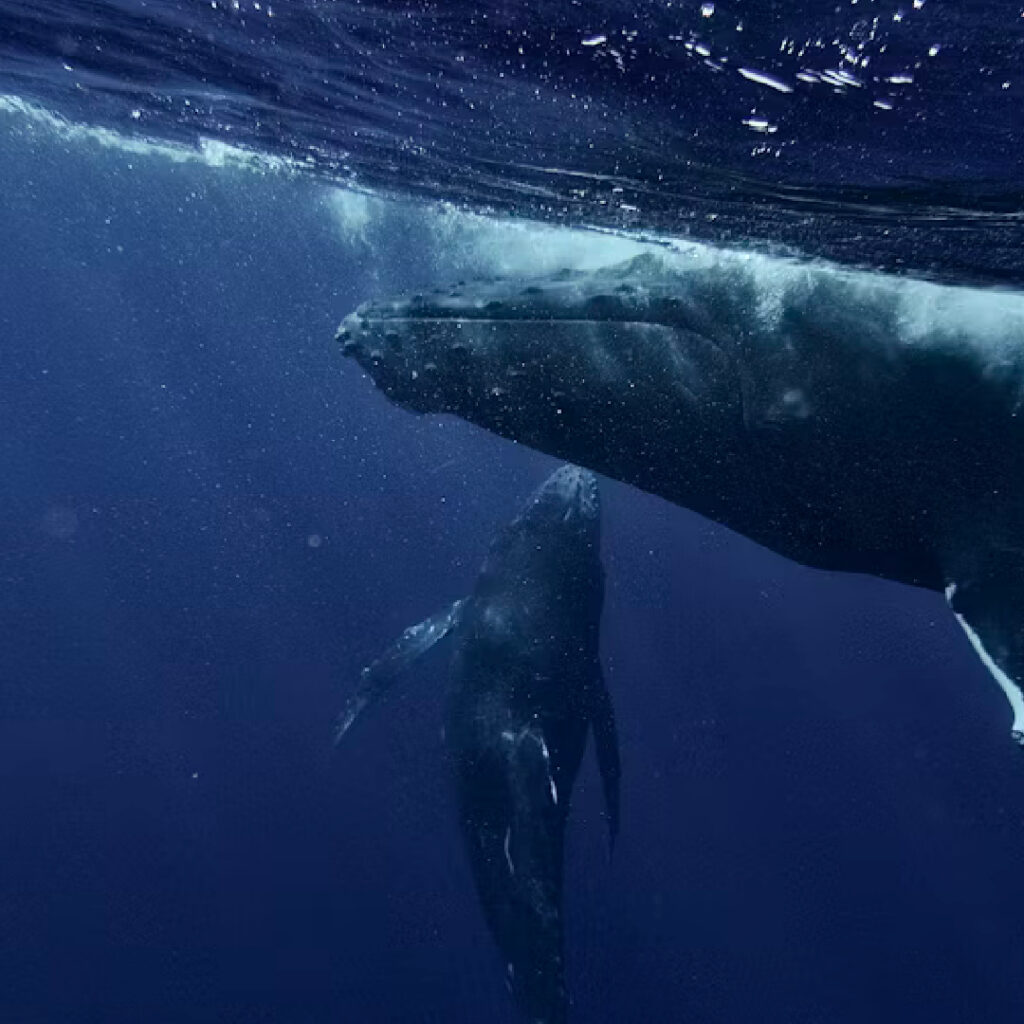
Cold waters like Alaska are rich in food, but dangerous for newborn calves. Warm tropical waters like those off Santa Teresa offer a safer nursery. There are fewer predators, calmer seas, and the warmth helps newborns conserve energy while they build strength.
A mother humpback will give birth to a calf that can weigh up to one ton at birth. Within minutes, that calf must swim to the surface for its first breath. Within days, it’s learning to move, to dive, to exist in a vast, shifting world.
For the next months, the mother rarely eats. She lives off stored fat while producing incredibly rich milk—up to 50% fat content—fueling the calf’s rapid growth.
It’s one of the most demanding acts of motherhood in the natural world.
Other super moms in nature
Humpback whales are absolutely in the top tier when it comes to maternal devotion. Months of fasting, constant protection, teaching a newborn how to survive in an ocean that doesn’t forgive mistakes—that’s elite-level motherhood.
But they’re not alone up there.
There are a few other mothers that match that energy… and some might even push it further in their own wild ways.
Elephants — The Memory Keepers
African elephant
If whales are the ocean’s mothers, elephants are the land’s matriarchs.
Elephant calves are raised not just by their mothers, but by entire female-led family groups. The bond between mother and calf is deep, emotional, and long-lasting—calves nurse for years and stay close to their mothers for over a decade.
Mothers are patient teachers, guiding them to water, food, and safety. They mourn their dead. They remember faces. They protect fiercely.
This isn’t just care—it’s culture being passed down.
Orcas — The Lifelong Sons
Orcinus orca
Now this one gets intense.
Male orcas often stay with their mothers for life. Not adolescence. Not early adulthood. Life.
Mothers continue to support their sons—sharing food, guiding them, even increasing their sons’ chances of survival and reproduction well into adulthood.
Some studies suggest post-menopausal females play critical leadership roles in pods, guiding entire families using decades of knowledge.
It’s not just a bond—it’s a lifelong alliance.
Octopus — The Ultimate Sacrifice






Giant Pacific octopus
This one is raw.
A mother octopus lays thousands of eggs and then spends months—sometimes up to a year—guarding them without eating.
She cleans them, oxygenates them, protects them from predators.
And when they hatch?
She dies.
No recovery. No second round. Her entire existence funnels into that one act of motherhood.
It’s less a bond over time—and more a complete, final offering.
Polar Bears — Survival School
Polar bear
In one of the harshest environments on Earth, polar bear mothers raise their cubs alone.
They give birth in dens during winter, then emerge months later into a frozen world where every step matters. Cubs stay with their mothers for up to 2.5 years, learning how to hunt, navigate ice, and survive.
One wrong lesson out there—and it’s over.
So every move is deliberate.
Orangutans — The Longest Childhood
Orangutan
If patience had a face, it might look like this.
Orangutan infants stay with their mothers for up to 8 years—one of the longest dependency periods of any animal.
Everything is taught: what to eat, how to climb, where to find shelter, how to read the forest.
It’s slow, intentional, deeply attentive parenting.
No rush. Just time.
And Back to the Ocean…
What makes humpback whales so striking isn’t just the care—it’s the environment.
Open ocean. No hiding places. Constant movement.
A calf has to learn fast, and the mother has to be everything at once—protector, teacher, guide, and fuel source.
And she does it while not eating, navigating thousands of kilometers, and staying alert in a world where danger can come from below or above.
So Who’s “Most Connected”?
That’s the wrong question, honestly.
Nature doesn’t rank love like a competition.
It adapts it.
- Elephants build community around it
- Orcas extend it for life
- Octopus compress it into one final act
- Orangutans stretch it across years
- Whales carry it across oceans
Different environments. Different pressures. Same underlying force:
Make sure the next generation survives. No matter the cost.
And when you’re out there off Santa Teresa, watching a humpback mother nudge her calf to the surface for air…
You’re not just watching a whale.
You’re watching one version of a story that’s being told across the entire planet—in different forms, in different landscapes—but always with that same quiet intensity.
Life, insisting on continuing.
The first months of a whale calf’s life are far more delicate than most people realize. A newborn humpback enters the world without the thick insulating blubber of an adult whale, making cold northern feeding waters incredibly dangerous for a young calf. In the warm Pacific waters off Costa Rica, however, the calf can conserve energy instead of burning it simply trying to stay alive. That energy instead goes into growth, coordination, and learning.
Marine biologists have observed calves constantly mirroring their mothers—learning how to surface, how to control their enormous bodies, how to time their dives and movements in rhythm with the ocean around them. In many ways, the warm tropical waters function as a giant protected nursery, giving new life the calmest possible beginning before the long migration north eventually begins.
It’s a reminder that across nature, life often grows strongest when its first chapter begins in safety, closeness, nourishment, and calm.
The Most Powerful Moms in the Natural World.
What They Eat—and When They Don’t
Here’s something that surprises most people: whales don’t come here to feed.
Humpbacks feed almost exclusively in colder waters, consuming massive quantities of krill and small fish. During feeding season, a single whale can eat up to 1.5 tons of food per day.
But during their time in Costa Rica, they fast.
They rely entirely on the energy reserves built up in colder regions. Think of it as a long-distance athlete running on stored fuel—except the race is thousands of kilometers long, and the stakes are life itself.
Love, Songs, and Ocean Communities
Whales are not solitary drifters. They form loose social networks, communicate across vast distances, and exhibit behaviors that suggest emotional intelligence.
Males compete for females through displays of strength and endurance, but also through song. These underwater symphonies can last for hours, repeating patterns that shift and evolve over time.
There’s also evidence of cooperation—groups working together to herd fish, protect calves, or navigate long migrations.
And then there are the quiet moments. A mother and calf moving in sync. A gentle rise to the surface. A slow, deliberate dive.
It doesn’t feel random. It feels intentional.
And the deeper scientists study whales, the harder it becomes to dismiss their emotional complexity. Humpback whales have repeatedly been documented intervening when orcas attack not only whale calves, but seals and other marine mammals as well. Researchers have witnessed humpbacks placing themselves directly between predators and vulnerable animals, even lifting smaller creatures onto their bodies to shield them from danger.
No one fully understands why they do this. Some scientists believe it may be an extension of maternal instincts so powerful that distress calls trigger protective responses automatically. Others believe it points to a level of emotional awareness we are only beginning to understand.
What is clear is this: whales are not behaving like simple instinct-driven machines. They react dynamically, socially, and sometimes in ways that appear deeply compassionate.
Storms, Navigation, and Ancient Instinct
When storms roll in and the Pacific turns wild, whales don’t panic. They dive deeper, below the turbulence, where the ocean remains calm and steady.
Modern science is now revealing that whales may navigate the planet using a combination of senses almost impossible for humans to imagine. Evidence suggests they can detect Earth’s magnetic field, using it like a living compass during migrations that stretch thousands of kilometers across open ocean.
At the same time, whales exist inside a world built around sound. Because sound travels nearly five times faster underwater than in air, whales may also navigate through acoustic memory—recognizing coastlines, underwater geography, currents, and distant storms through the way sound moves across the sea.
Some researchers believe the ocean for whales is not experienced primarily as a visual world the way humans experience it, but as a vast landscape of vibration, echoes, pressure, and sound.
That helps explain how generations return to the same migration corridors with astonishing precision, even after traveling across enormous stretches of seemingly empty ocean.
Can you spot the dolphins?
A Dark Chapter: From Oil to Awareness
There was a time when whales weren’t seen as wonders—but as resources.
Before electricity, whale oil lit the lamps of cities across Europe and North America. Entire industries were built on hunting these animals, pushing many species to the brink of extinction.
Today, commercial whaling is largely banned, thanks in part to global efforts led by the International Whaling Commission.
That said, the story isn’t clean. Some countries still hunt whales under various justifications, and yes—byproducts have historically found their way into industries like cosmetics. While modern regulations have reduced this significantly, the legacy remains a reminder of how easily we can lose what we don’t protect.
Intelligence Beyond Measure
Whales have some of the largest brains on the planet, with structures linked to emotion, memory, and complex social behavior.
They recognize individuals. They teach their young. They adapt songs across generations.
Whale brains also contain specialized cells called von Economo neurons, also found in humans, elephants, dolphins, and great apes. These neurons are associated with empathy, emotional processing, social awareness, and rapid decision-making.
Marine biologists have documented mothers carrying dead calves for days, sometimes weeks, refusing to leave them behind even while exhausting themselves physically. That behavior has now been observed across multiple whale and dolphin species around the world.
Science cannot fully explain emotion in whales.
But it can no longer dismiss the possibility of it.
And then there’s the question people whisper more than ask: Are they just animals—or something more?
We don’t have that answer.
But when you’re out there, watching a 40-ton being rise from the deep, look around, and disappear again beneath the surface… it’s hard not to feel like you’re in the presence of something ancient, aware, and deeply connected to this planet.
The Ocean Is Louder Than It Used to Be
For millions of years, whales evolved in oceans filled mostly with natural sound: storms, waves, rain, underwater earthquakes, and the calls of other marine life.
Then humans changed the ocean.
Modern shipping traffic, sonar, seismic testing, and industrial noise now fill many migration routes with constant low-frequency sound—the same frequency range many whales use to communicate.
Scientists believe this rising wall of noise may interfere with communication between mothers and calves, migration, feeding coordination, and mating calls.
Imagine trying to hear your family across an entire city while construction equipment roars nonstop around you.
That is increasingly becoming the reality of the modern ocean.
And still, despite everything humanity has placed in their path, the whales continue returning to these same warm waters off Santa Teresa year after year.
Whale Watching in Santa Teresa: A Front Row Seat
This is where it all comes together.
Santa Teresa isn’t just a surf town—it’s a vantage point into one of the greatest migrations on Earth. Local tours head out into the open Pacific, often spotting whales just a short distance from shore during peak season.
You might see a breach that shakes the horizon. A tail slap echoing across the water. A mother guiding her calf through its first journey.
Or you might just sit in stillness, scanning the blue, waiting.
Because out here, patience is part of the experience.
And when it happens—it hits differently.
Those who have already witnessed these giants in the water know the feeling that comes with it. And if you haven’t yet had the opportunity, you’ve come to the right place.
Thinking about heading out there? Here’s what you should know before you step on the boat.
Other facts, whale watching
Whale Facts That Will Change How You See the Ocean
How Long Do Whales Live—and Do the Oldest Ones Pass Here?
Humpback whales (Megaptera novaeangliae), the ones you’re most likely seeing off Santa Teresa, live 45–90 years.
That means a whale breaching offshore today could have been swimming these same migration routes before Santa Teresa had roads, before surf camps, before most of this coastline was touched.
There are whales that live far longer. The bowhead whale (Balaena mysticetus) can live over 200 years—but those ancient giants stay in the Arctic and never come this far south.
…but the ones that are have been making this journey longer than most human lives.
What Do They Eat—and How Does That Connect to Our Beaches?
Humpbacks don’t come to Costa Rica to feed—but what they eat is directly tied to what you sometimes see along the shoreline.
In colder waters like Alaska, they feed on:
- Sardines
- Anchovies
- Krill
Using a coordinated technique called bubble net feeding, where whales spiral upward, trapping fish into tight balls before lunging through them.
How Big Is a Whale—Really?
At Birth:
- Around 1 ton ….. Roughly the size of a small car
As Adults:
- Up to 40 tons …That’s about: 25–30 cows, Or two full-size school buses
Length:
- Up to 16 meters (50+ feet) …. Half a basketball court, Or 4–5 pickup trucks lined up end to end
And calves grow fast—gaining up to 40–50 kg (90–110 lbs) per day.
That’s like a newborn adding the weight of a large dog… every single day.
How Many Babies Do They Have
Humpback reproduction is slow and intentional:
- One calf at a time
- Pregnancy lasts 11–12 months
- Females give birth every 2–3 years
- Over a lifetime: roughly 10–15 calves
So what happens in the “off years”?
They still migrate. Why?
- To mate again
- To stay connected to breeding grounds
- To reinforce migratory memory (especially younger whales)
This isn’t just reproduction—it’s tradition, repeated across generations.
What Do the Males Do—And Do They Help Raise Calves?
Male humpbacks also travel all the way to Costa Rica—but their role is very different.
They:
- Compete with other males
- Escort females
- Sing long, evolving songs that can last for hours
But once a calf is born? They’re gone. There’s no father involvement in raising the young.
Everything you see—a calf learning to surface, to swim, to survive—is guided entirely by the mother.
How Do Whales Sleep If They Have to Breathe?
Whales don’t get the luxury of “switching off” the way we do. Humans breathe automatically. We fall asleep, and our body takes over. Whales don’t have that system.
Every breath is intentional—controlled by the brain. So if a whale were to fall into a deep, unconscious sleep like we do… it wouldn’t breathe. So evolution gave them a different path.
They use something called unihemispheric sleep:
- One half of the brain rests
- The other half stays awake
That awake side handles:
- Breathing
- Awareness of surroundings
- Basic movement
Then they switch.
Are Whales Ever Using 100% of Their Brain?
Yes—but only when they are fully active.
When traveling, socializing, feeding (in colder waters), or responding to danger, both hemispheres are engaged.
That’s when a whale is fully alert—navigating, communicating, reacting.
But during rest cycles, they are never fully asleep and rarely, if ever, fully unconscious.
Even in their deepest rest, part of the brain is always on.
How Long Do Whales Sleep?
Whales don’t sleep in one long stretch like humans. Instead, they rest in short cycles throughout the day and night. Each rest period can last from minutes to around 30 minutes. These cycles repeat many times over a 24-hour period.
So instead of one long sleep, they accumulate rest in pieces—like drifting in and out of a half-dream.
Do They Sleep at Night or During the Day?
Both. Whales aren’t strictly day or night sleepers. They rest whenever conditions allow:
- Calm water
- Low activity
- Safe surroundings
Out here off Santa Teresa, that might mean resting quietly in open water, sometimes just beyond the surf line—completely unnoticed.
Where Do They Go When They Sleep?
They don’t go anywhere special. They often remain: Near the surface, Moving very slowly, Or almost completely still. This behavior is sometimes called “logging”—because from a distance, they look like a floating log on the water.
You could be looking right at one… and not even realize it’s a whale at rest.
Why Stay Partially Awake (Beyond Breathing)?
Breathing is the main reason—but not the only one. That awake half of the brain also helps with: Awareness of predators (especially for calves), Navigation, Staying oriented within currents
For a mother and calf, this is critical.
Even during rest, the mother remains partially alert—tracking her calf, adjusting position, staying ready. It’s not just sleep. It’s rest with responsibility. Just a life lived in cycles of awareness and rest— switching sides, staying present, always ready to rise for air.
Pause on That for a Second
Imagine living like that, No full night’s sleep. No drifting into complete unconsciousness.
Every breath a decision. And still they cross oceans, raise their young, sing through the depths, and return—year after year—to the same stretch of water off Santa Teresa.
Do They Really Travel That Far—or Just Along One Path?
Humpbacks are capable of traveling across entire oceans—but most don’t wander randomly. They follow specific migratory routes, passed down through generations.
For whales off Santa Teresa, that means:
- From Alaska down to Costa Rica
- Or from Antarctica up to these same waters
Distances of up to 8,000 km (5,000 miles) each way.
They could cross east to west. But instead, they return to the same places—again and again.
It’s not just instinct. It’s learned migration, almost like a cultural map carried through generations.
The Heart of a Whale
The Balaenoptera musculus—the Blue Whale – the largest animal ever to live—has a heart weighing about 180 kg (400 lbs).
Picture: 2–3 adult humans pressed together, Or a large motorcycle
Its heartbeat can travel long distances underwater because Sound moves faster and farther in water and The low-frequency pulse carries efficiently,
Now compare that to humpbacks: Smaller than blue whales, but still massive. Their hearts are proportionally large, built for long dives and migration
And yes—blue whales are larger than humpbacks.
They are the true giants.
Do Whales Help the Planet Breathe?
This is one of the most powerful—and least known—facts.
When whales dive and surface, they create what scientists call the “whale pump”:
- Nutrients are brought from deep water to the surface
- This feeds phytoplankton—tiny ocean plants
Phytoplankton produce a significant portion of the Earth’s oxygen.
So in a very real way: Whales help fuel the system that helps the planet breathe.
Think of it like this: Each whale is not just an animal… …it’s a moving link in a global life-support system.
From the Hillside: Whale Watching Without Leaving Home
There are mornings in Santa Teresa and Mal País when the ocean looks calm, almost empty—and then, out on the horizon, a sudden white burst rises and disappears. A breach. From the hillside homes tucked into the jungle, you don’t need a boat to witness it. Coffee in hand, feet up, eyes scanning that deep blue line… and every so often, the ocean reveals what’s passing through. It’s a quieter kind of whale watching—no engines, no rush—just patience and perspective. The kind that reminds you these giants are moving whether we chase them or not.
Want a Closer Look? (What to Use from the Hillside)
If you want to bring those distant splashes into focus, skip cheap binoculars and go for a spotting scope—the same style used by birders and marine watchers.
What works best here:
- Magnification: 20x–60x zoom (adjustable is key)
- Objective lens: 60–80mm (handles ocean glare better)
- Tripod: essential—handheld won’t cut it at distance
Solid, reliable options: Vortex Diamondback HD 20-60×60 Spotting Scope. Celestron Ultima 80 Spotti.ng Scope. Pro tip: Early morning light + calm seas = best chance to spot blows (that misty exhale). Once you see one, keep your scope trained there—whales surface in rhythms.
A hillside, a horizon, and a little patience—that’s all it takes to turn your view into a front-row seat.
Final Reflection
The whales passing Santa Teresa are not just visitors.
They are:
- Travelers crossing hemispheres
- Mothers raising life in motion
- Keepers of routes older than memory
- And quiet engineers of the ocean’s balance
And most days… they’re doing all of this just beyond the break—while the beach carries on, unaware.
Out on the Water: A Front-Row Seat to the Migration
When the season turns and the whales arrive, the same local boats that head out at dawn for fishing often become your ride into something far bigger. These captains know these waters by feel—currents, wind, where life gathers—and it’s not uncommon for them to drift alongside a mother and her calf as they move through the open Pacific.
No chasing. No performance. Just a quiet parallel moment, engines low, everyone on board suddenly still.
Add in pods of dolphins weaving through the wake, sea turtles surfacing nearby, and frigate birds circling overhead, and the whole experience shifts from simple tour to full immersion in the living Pacific.
If you want to step off the beach and into their world, this is your chance.
👉 Explore and book your whale watching tour with our trusted local operators here.
Final Thought: Respect the Passage
Whale watching isn’t about chasing. It’s about observing, respecting distance, and understanding that we are visitors in their world.
These animals have been making this journey long before we built roads, hotels, or beach towns.
They don’t need us.
But we need them—if only to remind us that there is still something vast, intelligent, wild, and beautifully untamed moving through this world.
And sometimes, if you’re lucky, it passes right in front of Santa Teresa.