



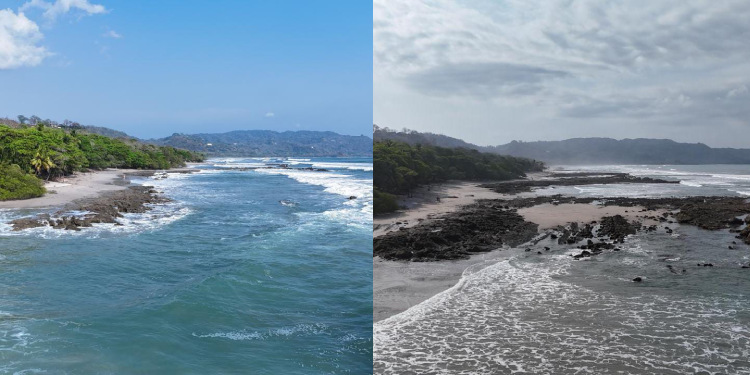
Physics is very valuable scientific knowledge, and for surfers, with time and experience, it becomes part of their strategy to know when it is time to paddle out… to know when it is the right time to go surfing and find the most convenient conditions, to enjoy the best session of the day; and, when it is the right moment, you may ride the best waves of your life.
Mastering Ocean Dynamics Science
To understand what happens behind the unbelievable power of tides, and how they affect waves, is key for surfers at all levels. It helps them choose the right time of the day to find the best possible conditions at any surf spot in the world. This includes considering the times of the tides and their dynamic with the specific characteristics of the surf break location. Enjoy reading.





Unraveling the Mystery of Tides
Tides are the consequence of gravitational energy from the Moon and the Sun, that creates a differential pull on Earth’s oceans, moving up and down in perfect rhythm the mass of water that covers the planet, creating what we know as tides.
This gravitational pull creates two bulges of ocean water—one on the side of the Earth facing the Moon, where the Moon’s gravity is strongest, and another on the opposite side, caused by the centrifugal force generated by the Earth-Moon system spinning together. Imagine the Earth encircled by a giant, shifting ring of water—like two hula hoops layered over each other—while the planet spins beneath them. As the Earth rotates, different areas pass through these bulges, creating the rise and fall of tides we experience each day.
Because of the Earth’s rotation cycle, one spin around its own axis, in general, we have cyclical high and low tides; two high tides and two low, four tides in about one full day.
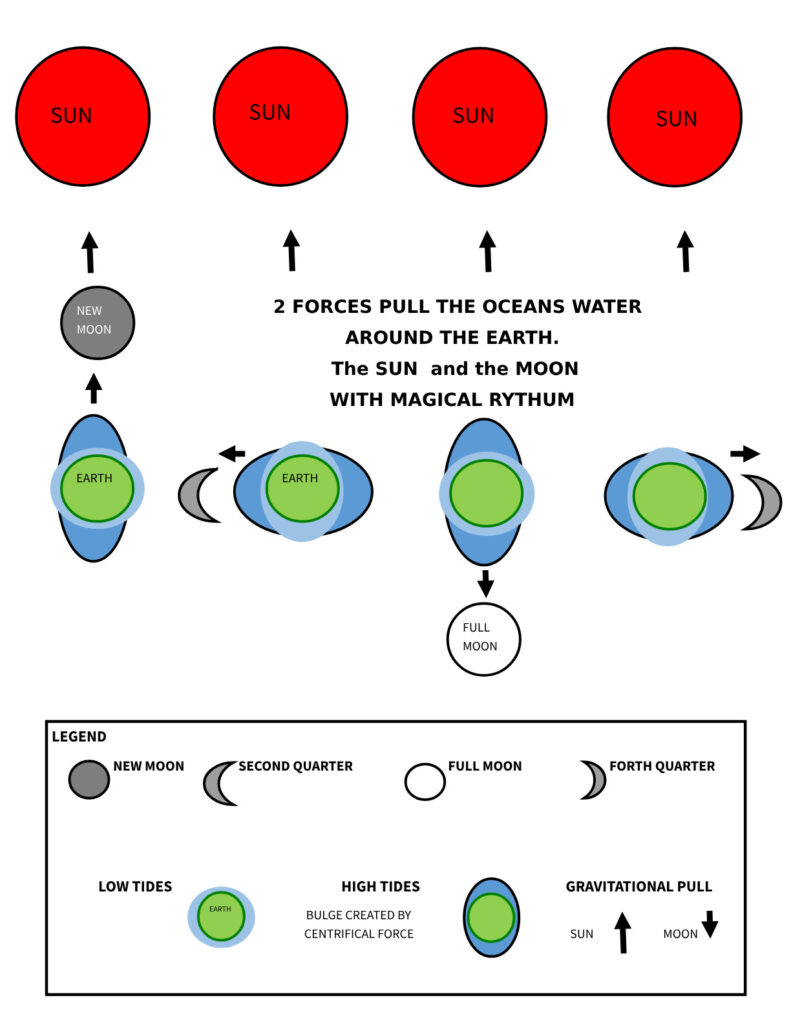
How the Moon Moves the Ocean: Understanding Tides and Surf in Santa Teresa.
Why Are There Approximately Four Tides a Day?
In general, most coastal places have semidiurnal tides, this means, two high tides and two low tides, every lunar day, which is 24 hours and 50 minutes. This is a consequence of the dual tidal bulges rotating around the Earth. Then the interval between successive high and low tides is about 6 hours and 12 minutes, which is roughly the time it takes the Earth to rotate one-quarter of a full spin.
Why Do Tides Shift About an Hour Later Every Day?
Tides follow the Moon, not the Sun. While our regular day is 24 hours long (based on the Sun), the Moon takes about 24 hours and 50 minutes to be back in the same spot in the sky. That’s because as the Earth spins, the Moon is also moving in its own orbit around us. So each day, the Earth has to turn a little more to catch up with the Moon. That extra 50 minutes is why the tides happen almost an hour later every day.
Factors That Influence Tidal Heights
The height difference between high and low tides is called Tidal Amplitude. This vertical difference between tides is determined by several factors:
The most important factor that influences ocean tides in Santa Teresa is the moon phase. When the Moon is new or full, it lines up with the Sun—either on the same side of the Earth or directly across from it.
This alignment increases the gravitational pull on the ocean, causing stronger tides, known as spring tides. These powerful tidal shifts can lead to bigger surf conditions and affect the best times to go surfing in Santa Teresa.
When the Moon is at a first or third-quarter phase (half-moon), it pulls at a different angle from the Sun. Their gravitational forces partially cancel each other out, leading to weaker tidal movement. These are called neap tides, and they result in smaller tide amplitude, something surfers should consider when checking the Santa Teresa surf forecast or planning their surf sessions based on tides.
How the Moon’s Distance Affects Tides in Santa Teresa
The Moon doesn’t orbit Earth in a perfect circle—it follows an elliptical path, which means it’s sometimes closer to us and sometimes farther away. When the Moon is closest to Earth, a point called perigee, its gravitational pull is stronger, which causes more extreme tides. These higher high tides and lower low tides can create powerful surf conditions in Santa Teresa, especially during spring tides.
Solar declination and Earth’s axial tilt are also factors that change the position of the Earth in relation to its position with the Moon, and this changes the gravitational energy that the oceans receive, changing tides amplitude seasonally, as the Earth orbits the Sun.
Why Are Ocean Tides Predictable? The Science Explained
The tides are governed by gravitational mechanics, which are mathematically precise and repetitive, or cyclical, so they are measured and predicted using tidal models derived from astronomical data that can perfectly predict tides, days, months, or years in advance.
Must-Know Tide Insights for Surfing Santa Teresa
It is very important for surfers to seriously take the time to carefully observe the specific characteristics of each wave break location. Tidal amplitude and behavior are greatly influenced by bathymetry (the underwater topography), as well as coastal shapes and formations, which can either dampen or amplify tides—giving more or less power to the waves. Because of this, the same surf spot in Santa Teresa can display completely different, or even opposite, wave conditions depending on the tide.
A wave may break and behave one way during low tide, forming further out, in shallower water or over exposed sandbars and reefs. Then, during high tide, that same wave may slow down, close out near shore, or even vanish altogether. Some spots are tide-dependent, only breaking at specific tidal windows—knowing this is crucial for scoring good sessions, finding the exact type of wave that you like, all here in Santa Teresa.
Before we wrap up, we must consider tides from a surf safety perspective. Changing tides can cover or expose hazards like sharp reefs and rocks, and they can significantly alter the strength of the waves, as well as the intensity of tidal currents and rip currents—especially around points, bays, and river mouths in Costa Rica.
Surfers rely on tide knowledge and accurate surf forecasts to strategically plan their sessions—and even entire surf trips to Santa Teresa. Honing this skill with awareness and dedication can mean the difference between disappointing conditions and finding yourself in the water with perfect waves and unforgettable rides. Stay safe, time it right, and enjoy the surf.
Conclusion: Surf Smart, Tune Into the Tides
Now that you’ve learned the key science behind the tides and how they affect your surf sessions, it’s time to put this knowledge into practice! Whether you’re a beginner or an experienced surfer in Santa Teresa, understanding the tides will help you catch the best waves, stay safe, and have an unforgettable surf experience. Keep an eye on those Santa Teresa surf forecasts, plan your sessions around the tides, and enjoy the rhythm of the ocean. Ride the waves, and may your sessions always be filled with great rides!
MATIAS