







.dirt-road-relaunch #post-title { font-family: 'Playfair Display', Georgia, serif; font-weight:700; font-size:2.2rem; letter-spacing:-0.4px; margin-bottom:6px; }
.dirt-road-relaunch .eyebrow { display:inline-block; font-size:0.82rem; letter-spacing:1px; text-transform:uppercase; color:#2596be; margin-bottom:10px; font-weight:600; }
.dirt-road-relaunch .lede { font-size:1.08rem; color:#222; margin:14px 0 12px 0; font-weight:500; }
.dirt-road-relaunch p { margin:10px 0; font-size:1rem; color:#222; }
.dirt-road-relaunch h2 { font-size:1.25rem; color:#0b3d6b; margin-top:20px; }
.dirt-road-relaunch h3 { font-size:1.05rem; color:#0b3d6b; }
.dirt-road-relaunch .section { padding:14px 0; border-top:1px solid rgba(15,23,42,0.04); }
/* Drop cap for first paragraph to add visual flair without changing text */ .dirt-road-relaunch section:first-of-type p:first-of-type:first-letter { float:left; font-size:3.6rem; line-height:0.78; padding-right:10px; font-weight:700; font-family:'Playfair Display', Georgia, serif; color:#0b3d6b; margin-top:4px; }
/* Soft accent bar beside headings */ .dirt-road-relaunch h2::before { content: ""; display:inline-block; width:6px; height:22px; background:linear-gradient(180deg,#2596be,#0b3d6b); margin-right:10px; vertical-align:middle; border-radius:3px; }
/* Emphasize the welcome line */ .dirt-road-relaunch .welcome { display:inline-block; padding:10px 14px; background:linear-gradient(180deg, rgba(37,150,190,0.06), rgba(11,61,107,0.02)); border-radius:10px; font-weight:600; margin-top:8px; }
/* Footer area */ .dirt-road-relaunch footer { margin-top:28px; border-top:1px solid rgba(15,23,42,0.04); padding-top:18px; display:flex; gap:12px; align-items:center; flex-wrap:wrap; }
/* Responsive tweaks */ @media (max-width:740px) { .dirt-road-relaunch { padding:18px; margin:18px; } .dirt-road-relaunch #post-title { font-size:1.6rem; } .dirt-road-relaunch .docked-hero { display:none; } .dirt-road-relaunch section:first-of-type p:first-of-type:first-letter { font-size:3rem; } }
Long before Santa Teresa found itself on the cover of travel blogs and investment portfolios, it was just a dusty dirt road winding through jungle and coastline—a place where fishermen, farmers, surfers, and seekers coexisted with monkeys, mango trees, and moonlit tides.
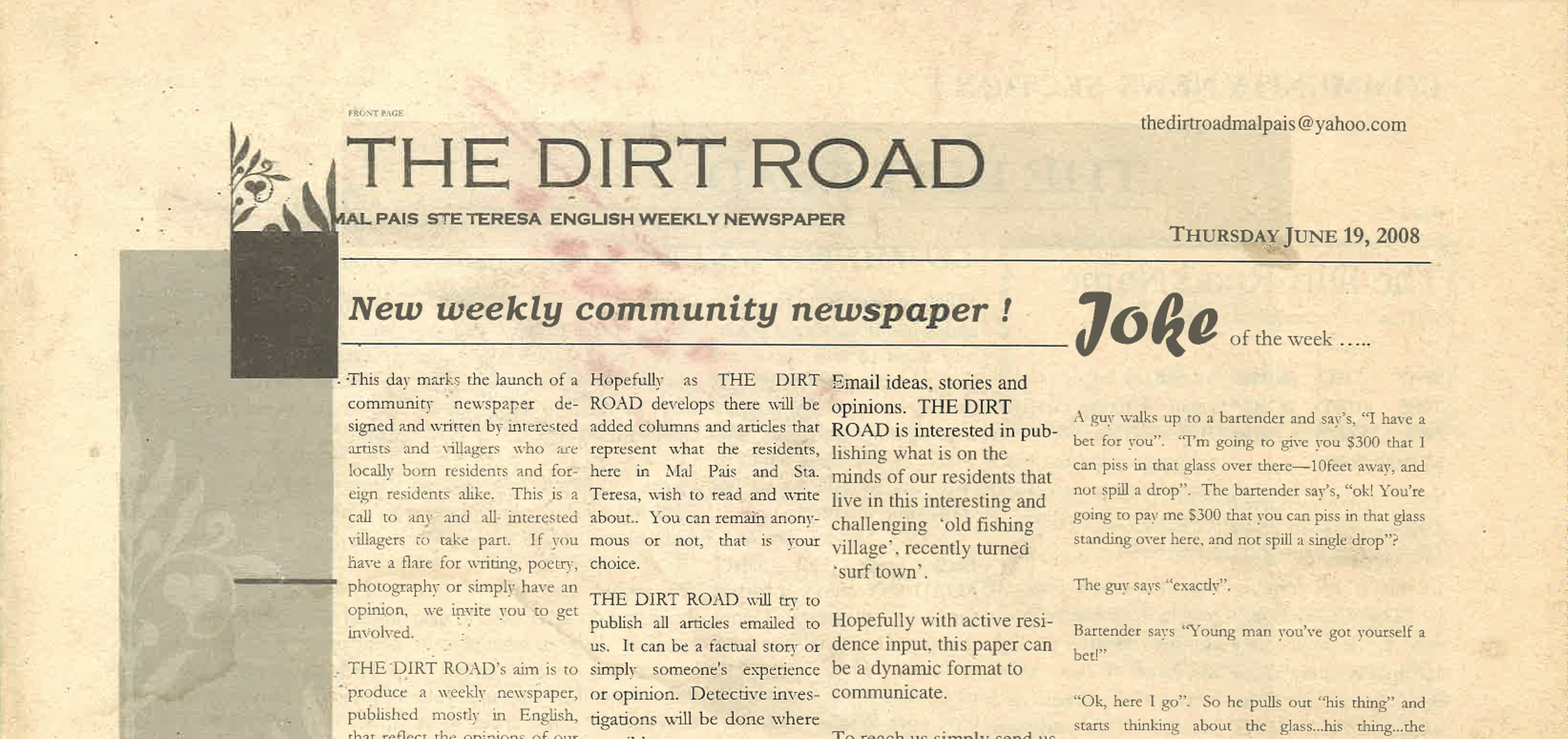
In 2008, the original Dirt Road Newspaper was born from this humble pulse. A printed paper, handwritten and heart-led, created to reflect the stories of the village, to support local businesses, and to document the magic happening in real time along the Nicoya coast.
For over a decade, it grew with the town—offering insight, humor, community news, interviews, nature reports, and restaurant reviews to the handful of us who called this place home. But in 2018, a family crisis needed support so the printed pages were paused.
Now, in 2025, the Santa Teresa Dirt Road returns—not on paper, but in pixels. A digital newspaper, reborn with the same love and grassroots fire, but with fresh tools, expanded reach, and a mission to rise the vibration of our village once more.
This relaunch isn’t just a comeback—it’s a calling.
We’re answering the call of the land, of the ocean, and of the people who still believe in community over competition, in jungle over concrete, and in the original essence of pura vida. I hope you will grow to love and appreciate the Santa Teresa Dirt Road newspaper again.
A Personal Journey, A Village Revival
I first stepped onto this soil in the early 1990s—one of the first Canadians to settle in what was then just Malpaís and a few scattered homes. I met a Cuban-New Yorker named Rubin, his neighbor Tomás, and their friend Ian. I worked at 1 of the 3 restaurants back then, and I watched as Costa Rican families, mostly from San Ramón, laid roots here. Families like the Leon´s, Moya’s, Senaida’s, Frank’s, and Rony’s—names that still echo in the breeze today. Many of them had their first children born here, starting new generational stories beneath the palms.
Back in the 70´s when MalPais was named Badlands for a reason, when Nature and malaria ruled over the human colonies’ , and when the hills of Santa Teresa were owned by a Nicaraguan investor who was later deported. The land was given back to the people through the EDA program, allowing Costa Rican citizens to farm the land, and after 15 years, earn the right with title and ownership. This place has always been about reclaiming, about rebirth.
And so is this newspaper.
View the First Edition of the Dirt Road Newspaper (2008)
We are thrilled to present the original edition of the Dirt Road Newspaper, published on June 28, 2008. This PDF offers a snapshot of our roots, showcasing the early stories and spirit that helped build the foundation of our community.
View PDF: Dirt Road Newspaper – 1st Edition (June 28, 2008)
Why Now?
Post-2018 and especially after the pandemic, the town saw a rapid shift—an influx of developers, investors, and new energies, some aligned with the spirit of the land… and others less so. Today, Santa Teresa is a complex blend of beauty and burden: pristine beaches still sparkle, but the pressure to build threatens to outpace the balance.
Amid this tension, a movement is growing—local associations are getting stronger, residents, and longtime souls working to protect nature, preserve culture, and create a future that honors the past. The Santa Teresa Dirt Road is our way of supporting, and hopefully amplifying that movement.
What We’re Building
A digital home for truthful storytelling, rooted in empathy, humor, and thoughtfulness—never preachy, always real.
A video channel, YouTube content, and interactive guides that connect locals, visitors, and the greater world to our corner of paradise.
Free business listings and maps, ensuring that all voices—new and established—are seen, supported, and celebrated.
A platform for contests, photo journals, visitor reflections, and spotlight stories, making it easy for everyone to participate and contribute.
A bridge between past and present, between nature and human, between old soul and curious newcomer.
We are not here to tell you how to live. We’re here to remind you why we chose to live here in the first place.
Whether you arrived in the ’90s with sand in your shoes and stars in your eyes, or just this year with a surfboard and a dream, this newspaper is your invitation to be part of the ongoing story.
The road may still be part dusty, the internet may lag, but the fire of community still burns bright.
Welcome back to the Dirt Road.